Sheet · a reading
The Swell and the Dwell
- Specimen
- Wild nights – Wild nights! — Fr269, J249
- Maker
- Emily Dickinson
- Written
- About late 1861, in Fascicle 11
- Manuscript
- Houghton Library, Harvard University — Poems: Packet VIII, Fascicle 11, MS Am 1118.3 (38b), one leaf in ink. Mounted below
- First printed
- Poems by Emily Dickinson, Second Series (Boston: Roberts Brothers, 1891), Book II — Love, poem VII, page 97, edited by T. W. Higginson and Mabel Loomis Todd
- This text
- R. W. Franklin’s reading of the manuscript, as published in the Emily Dickinson Archive. The line division after
moor –
is the manuscript’s own and Franklin records it - Read
- 8 September 2026
- Read by
- Ryan Boren
- Reply in verse
- Ryan Boren. Punctuation set for print; the words and the line breaks are his
- Terms
- Co-regulation · Safe space · Belonging · Bodymind · Somatic · Stimming · Glimmers · Limerence
Emily Dickinson wrote twelve lines asking for one night in harbour, and there is not a single indicative verb in them. Thirty years later her first editors printed the poem — one of them apologising for it in a letter as he did — and eight of her nine dashes did not survive the trip to the press. This sheet reads it as a description of co-regulation — the swell and the dwell of relational tides — and answers it in verse.
Wild nights – Wild nights! Were I with thee Wild nights should be Our luxury!
Futile – the winds – To a Heart in port – Done with the Compass – Done with the Chart!
Rowing in Eden – Ah – the Sea! Might I but moor – tonight – In thee!
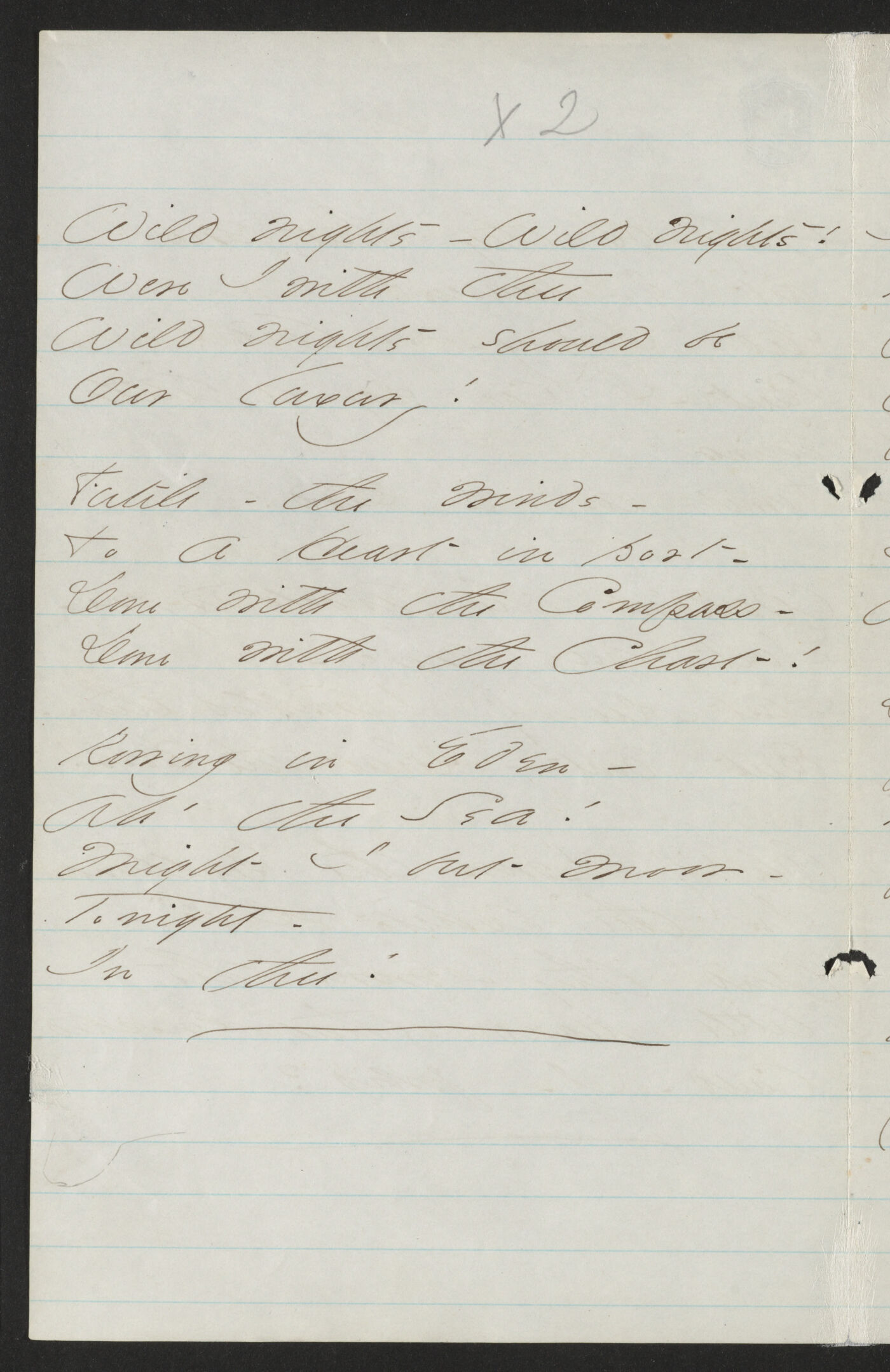
Tonight –stands alone because the leaf ran out of room, and everything that follows on this sheet follows from what two sets of editors did with that.
Erotic and cozy. Turbulent and safe. We share space that we co-make.
Passionate gratification segued to the calm co-regulation that is our shared balm.
To be in safe space with one you adore, basking in reciprocation and mutual understanding, that is a great feeling. That is THE feeling — craved by our kind.
Dickinson captures well the swell and the dwell of relational tides. The swell is of sensory passion and exploration, of bodyminds alive and alight in luxurious abandonment. The dwell is of belonging and legibility — where you can put down the compass and the chart and just be: accepted and understood.
Oh to be human, in a deep easy rhythm, of reciprocal need, held not in tension.
Stimmy glimmers Somatic release Sensory ease Regulated peace.
Calm quiescence, Denouement after arrival, Preceded by A love-tangled spiral.
Might I but moor In your heart and your body, In your mind and your soul, Woven delightfully.
We need not our masks Nor our constructs of gender. Let’s rest the guise And be our realest assemblage.
With the strength of limerence that has been requited and matched, Let’s be together And let the world pass.
Futile – the winds Link to this section
Read the second stanza slowly, because it does not say what people remember it saying. The storm does not stop. The winds are still blowing at the end of that line exactly as hard as they were at the beginning of it. What has changed is that they have become futile — a word about effect, not about strength — and the thing that made them futile is a location: To a Heart in port.
That is co-regulation, described more than a century before there was a word for it. Not a calm temperament. Not a coping skill. A place, and company, in which the same weather stops landing.
Co-regulation is when we complete the stress cycle with the support of a safe enough person.
A safe enough person is a person in safe & social mode. They have deep belly breathing, expressive face, soft gaze, calm heart rate, prosodic voice, and the ability to enjoy safe touch or closeness.
Safe enough.
Not safe. Not perfect. Enough — which is the whole reason a harbour is a harbour and not a fortress, and it is why Dickinson can leave the winds in the poem. A port that required the weather to be good would not be a port.
The clinical literature has spent decades measuring the wrong half of this. It looks for the regulated individual and finds a dysregulated one, and writes that down as a property of the person rather than of the room they were in. A 2026 paper puts the correction plainly:
Co-regulation distributes adaptive labour across the system rather than concentrating it within the individual. Environments are not passive backdrops to which people must adjust; they are active participants in regulatory dynamics.
Dickinson had already put the environment in the sentence. Futile – the winds – / To a Heart in port
is a claim about a system with two things in it, and the second thing is doing the work.
Done with the Compass – Done with the Chart Link to this section
Here is the line the whole sheet turns on, and it is worth being precise about what a compass and a chart are for. They are not what you use when you know where you are. They are what you use when you do not — instruments of continuous correction, consulted and reconsulted, every heading checked against a reading and adjusted before the next one.
That is masking, described as equipment. Check the face. Check the volume. Check whether that was too much. Correct. Check again. It is navigation, it never stops, and it is exhausting in exactly the way that holding a bearing in unfamiliar water is exhausting.
Dickinson does not say the navigator has arrived, or that the instruments were wrong. She says they are done with — put down, on the table, not needed in here. Helen Edgar names the same three things from the other end, as conditions rather than as relief:
Across education, healthcare, and employment, a common thread seems to emerge that safety is not only physical or psychological. It is sensory, attentional, relational, and political.
Safety involves being able to focus without constant interruption.
It involves communicating without fear of misinterpretation.
It involves participating without masking core aspects of identity.
Communicating without fear of misinterpretation is the chart. Focusing without constant interruption is the compass. And participating without masking core aspects of identity is the moment both of them go down on the table — which is what Ryan’s reply asks for in as many words: We need not our masks / Nor our constructs of gender.
This is also the difference between being included and belonging, and it is a difference the Stimpunks glossary refuses to let go of:
Belonging means more than being included. It means feeling understood, accepted, and able to participate without constantly having to explain yourself, hide parts of who you are, or push past exhaustion just to keep up.
Being included is being allowed on the boat. Belonging is being done with the compass.
Rowing in Eden Link to this section
Two words, and both of them are doing work that generations of readers have mostly spent on the second one.
Eden is before shame. Not before sex — before the part where somebody notices they are naked and reaches for a covering. That is a sentence about masking too, in the oldest available vocabulary.
And rowing is labour. It is rhythmic, repetitive, bilateral, whole-body work; it is the least ethereal verb available for what she is describing, and she chose it over floating, over drifting, over sailing. A body doing a repeated motion in time, and the doing of it is the pleasure. There is a word for that on this site:
Autistic adults highlighted the importance of stimming as an adaptive mechanism that helps them to soothe or communicate intense emotions or thoughts and thus objected to treatment that aims to eliminate the behaviour.
autisticin lower case; this site capitalizes Autistic, and the quotation keeps the authors’ usage.
Ryan’s reply puts it in a line: Stimmy glimmers / Somatic release / Sensory ease / Regulated peace.
Four nouns, no verb, and it is the same grammar Dickinson uses in Rowing in Eden – / Ah – the Sea!
— a state named rather than an action reported.
None of which is happening to a mind. It is happening to a bodymind, which is Margaret Price’s term and is not a decorative compound:
Mind is an embodied phenomenon. The mind is encoded in the brain as ever-changing webs of neural connectivity. The brain is part of the body, interconnected with the rest of the body by a vast network of nerves. The activity of the mind and body creates changes in the brain; changes in the brain affect both mind and embodiment. Mind, brain, and embodiment are intricately entwined in a single complex system. We’re not minds riding around in bodies, we’re bodyminds.
And now look at what Dickinson capitalizes. Heart. Compass. Chart. Sea. Eden. In her hand they are proper nouns — a common noun with a capital on it is an object with a label on it, which on a herbarium sheet is the difference between a plant and a specimen. She pins the Heart and the Compass to the page as things. The 1891 editors took four of those pins out, and we will come to that.
Might I but moor – tonight Link to this section
The poem asks for one night.
Not a life, not a vow, not an arrangement. Tonight. And the word for a small bounded moment of regulation that is worth having on its own terms, without being the down payment on anything, is glimmer — Deb Dana’s coinage out of polyvagal work, and the opposite of a trigger:
Deb Dana first used the term glimmers to describe “micro-moments of regulation that foster feelings of well-being.”
Glimmers are small but powerful moments when everything aligns; our focus, sensory needs, and emotions come together in a way that feels right. For Autistic people, these fleeting moments of joy, peace, or connection offer grounding and relief in a society that often feels overwhelming.
When everything aligns. That is a description of a night, not of a life, and the poem knows it. Might I but moor – tonight –
asks for the alignment and asks for nothing after it.
Which is where this sheet meets the one before it. Rossetti, writing in England in April 1861 — the same year Dickinson was sewing this leaf into Fascicle 11 — declines to promise anybody anything and holds the die uncast, free to come as free to go.
Dickinson asks for tonight. Two poems, one year, an ocean apart, and neither of them is asking to get on the escalator. One refuses the future and one does not mention it.
Were I with thee — the poem is in the subjunctive, all the way down Link to this section
Now the thing that is hiding in plain sight, and it is a fact about the grammar rather than an interpretation of the imagery. Count the finite verbs in this poem. There are three, and every one of them is a conditional:
Were I with thee
— subjunctive.Wild nights should be / Our luxury
— conditional, and dependent on the line above it.Might I but moor
— optative, and a question that the poem never answers.
Everything else has no finite verb at all. Futile – the winds –
has none. Done with the Compass –
is a participle. Rowing in Eden –
is a participle. Ah – the Sea!
is an exclamation with nothing in it that happens. Nothing in this poem takes place. Twelve lines, three verbs, no indicative — it is a poem made entirely of a mood, in both senses of the word.
And that is the strict definition of the term Ryan’s last stanza reaches for:
Limerence is a state of involuntary obsession with another person. The experience of limerence is different from love or lust in that it is based on the uncertainty that the person you desire, called the “limerent object” in the literature, also desires you. Since limerence is the desire to be desired, it is a cognitive, as well as physical, and emotional experience. As the focus of limerence is whether or not the object of desire reciprocates the feelings, rather than actually falling in love with the person, it is almost always one-sided.
Uncertainty is not a symptom of limerence. It is the definition. Take the uncertainty out and the word does not apply any more — which is why the poem’s grammar is the evidence for the diagnosis. A speaker who was moored would have written an indicative sentence.
So watch what the reply does with its own verbs, because it is not doing the same thing at all. It opens flat in the present indicative — We share space / that we co-make
— borrows her subjunctive exactly once, at the centre, where it repeats Might I but moor
back to her, and then ends somewhere she never goes: Let’s be together / And let the world pass.
First person plural, hortative, addressed to somebody who is expected to answer.
Three moods against her one. That is the actual distance between the two poems on this sheet, and it is measurable in the verbs rather than argued from the feeling.
Let us alter as little as possible Link to this section
On 21 April 1891, from 25 Buckingham Street in Cambridge, Massachusetts, Thomas Wentworth Higginson wrote to his co-editor Mabel Loomis Todd about the volume they were assembling. He enclosed a preliminary selection. He wrote one sentence about editorial policy and then, immediately, a paragraph about this poem.
Let us alter as little as possible, now that the public ear is opened.
One poem only I dread a little to print—that wonderful “Wild Nights,”—lest the malignant read into it more than that virgin recluse ever dreamed of putting there. Has Miss Lavinia any shrinking about it? You will understand & pardon my solicitude. Yet what a loss to omit it! Indeed it is not to be omitted.
Miss Laviniais Lavinia Dickinson, the poet’s sister.
Read that letter as a whole and it is stranger than the famous sentence in the middle of it. Higginson is frightened of the poem, protective of a woman he is describing as a virgin recluse
less than five years after her death, worried about what the malignant
will see — and he prints it anyway, and the reason he gives is that leaving it out would be a loss. He knew exactly what was in it. The apparatus of denial and the decision to publish are in the same paragraph.
He also wrote let us alter as little as possible
two lines earlier. Here is what reached page 97.
| As Franklin reads the leaf | 1891, page 97 |
|---|---|
| Wild nights – Wild nights! | WILD nights ! Wild nights ! |
| Futile – the winds – | Futile the winds |
| To a Heart in port – | To a heart in port, — |
| Done with the Compass – | Done with the compass, |
| Done with the Chart! | Done with the chart. |
| Ah – the Sea! | Ah ! the sea ! |
| Might I but moor – tonight – In thee! | Might I but moor To-night in thee ! |
Nine dashes go in and one comes out — the em dash at the end of line 6, and even that one has acquired a comma in front of it. Four of her capitals are lowered: Heart, Compass, Chart, Sea. Eden keeps its capital, because Eden is a proper noun in anybody’s grammar and the other four were only proper nouns in hers. Three new exclamation marks and three new commas arrive. A full stop replaces the exclamation at the end of the second stanza. The poem opens with a two-line drop-cap W, which is how the volume opens every poem, so WILD
is a compositor’s capital and the word is Wild; the same initial is why line 2 sits inset, and that indent is the drop cap rather than an editorial one. Every exclamation mark in the book has a space in front of it, which is the volume’s house style and not her pointing. And where the manuscript has a dash between the two halves of line 1, the compositor set an unusually wide space.
The lineation is the one change that is not a tidy, and it deserves better than it usually gets. Dickinson wrote Might I but moor –
and ran out of leaf, so Tonight –
went on the line below. Franklin records that division in his textual notes and reads through it: the verse line is Might I but moor – tonight –
, and the physical break is an accident of paper. Todd and Higginson set what was in front of them. Both are defensible. One editor reproduced the poem and the other reproduced the leaf, and the argument between them is the whole argument about how to print Dickinson, arriving in 1891 at line 11 of this poem and never really leaving.
What is not defensible is a text that has been through both and kept neither.
A word missing from the copy you will find Link to this section
The Poetry Foundation prints Franklin, credits the edition, and gets it right. It also files the poem under Queer Love Poems, which is a reading rather than a fact about her, and a good one.
The Academy of American Poets prints something else. Read on 8 September 2026, poets.org gives a text that has been through the 1891 tidy and the modern restoration and come out as neither: the dashes are back, so it is not 1891; heart, compass, chart and sea are lower case, so it is not the manuscript; Ah, the sea!
has a comma that is in no printing we have looked at; Wild Nights
is capitalized where neither the leaf nor 1891 capitalizes it; and line 11 reads:
| Franklin, and the leaf | poets.org, 8 September 2026 |
|---|---|
| Might I but moor – tonight – | Might I moor – Tonight – |
The word but is gone, and with it a beat of the line and most of its meaning. Might I but moor is a plea with a limit written into it — if I could only, if I might just, asking for the smallest possible version of the thing. Might I moor is a request for permission to dock. The page carries no edition, no editor and no date; it says This poem is in the public domain,
which is true of the poem and tells you nothing about the text.
This is the third time the register has caught this shape of error, and it arrives the same way every time. Woolf had two texts and both were hers. Rossetti has a colon in her first printing where every circulating copy has a full stop. Here a poem that asks to be moored has had the hinge taken out of the asking. Name the printing, or do not quote.
One more thing, and it is about our own method rather than anybody else’s. Page 97 was read in three separately scanned copies. The first two — both digitised from University of California Libraries holdings — agree with each other and are wrong: a broken piece of type makes line 11 read mocr instead of moor, identically in both. The University of Toronto copy has the word intact. Two scans that agree are not two witnesses if they came out of one library, and this site had already written the lesson down once, about a scan of a Child ballad, and still nearly published a broken letter as a variant. The finding is not in the text of the poem; it is in the way we check it.
What this sheet will not tidy Link to this section
Dickinson was not writing this. She had no word for co-regulation, no glossary, no nervous system in the sense the term above is using, and no relationship escalator to decline. She wrote twelve lines to a thee
the leaf does not name and sewed them into a fascicle. Reading her forward until she arrives at a regulated bodymind is our move, and it is the method of this whole site rather than a discovery about her. The language is hers. The use is ours.
The speaker of this poem is not in port. This is the hardest thing on the sheet and it undercuts most of the comfort in it, so it belongs here rather than in a footnote. The winds are futile to a Heart in port — and the speaker is outside, in the weather, asking to be let in. Might I but moor
is a question the poem does not answer, in a poem with no indicative verb in it. Everything warm described above is a description of the thing this poem wants. The reply on this sheet is written from inside the harbour; the specimen is not.
Limerence requited is not limerence. With the strength of limerence / that has been requited and matched
asks for Tennov’s intensity with Tennov’s uncertainty removed, and once the uncertainty is gone the word has stopped describing the thing. That is a deliberate turn and it is the reply’s best line, but the credit for limerence stays with Dorothy Tennov and the requited version is ours. If we changed the words, they are ours — and if we changed the meaning while keeping the word, the same rule applies.
Helen’s assemblage runs the other way. In her sentence the assemblages are the restrictive ones people take flight from — Deleuze and Guattari’s lines of flight, moving away from restrictive assemblages
. Be our realest assemblage
asks for one worth arriving at. The word covers both in Deleuze and Guattari, so this is an extension rather than a misuse; but hers is a sentence about escape and this is a line about arrival, and they are not the same sentence.
We do not know who thee
is, and this sheet is not going to guess. The addressee is ungendered in the manuscript, the identity of Dickinson’s addressees is unsettled scholarship, and Higginson’s virgin recluse
is evidence about Higginson. A queer reading of this poem does not need a biography to stand up, and it does not get one here. Not knowing who she was writing to is not the same as her writing to nobody.
We read the facsimile and we are not setting our own readings against Franklin’s. The leaf is mounted above and you can look at it. What is on it is a great many short strokes of varying length and angle, some of which are dashes, some of which are exclamation marks and some of which are the tail of the letter before them. Deciding which is which is the work of the two variorum editions and not of an afternoon, and it is precisely why this sheet names its edition in the label instead of claiming the manuscript.
The facsimile is not in the public domain, and everything else mounted on this site is. The poem is public domain. Harvard’s photograph of the leaf is offered by the Emily Dickinson Archive under CC BY-NC-ND 3.0, and we take them at their word rather than arguing about whether a photograph of a flat public-domain manuscript can carry a copyright of its own. That makes this the first plate here that is licensed rather than free, the credit line is the archive’s required one, and the file is unaltered.
And the reply is for somebody. It was written to a person, not to a readership, and it is mounted here at its author’s request with its punctuation set for print and nothing else touched. A sheet cannot be a private letter and a public plate at the same time. This one is both, and that is a decision rather than an oversight.
Might I but moor.
Queering Earth Sheet No. 6 Accessioned
Provenance Mounted . Label corrected twice and re-determined twice — two scans that agreed with each other and were both wrong, and a missing word.