Sheet · a reading
The Five Unmistakable Marks
A definition recited for a beast nobody has ever seen, a word that does its work by being empty, and the person who coined ours having to say out loud that she did.
- Specimen
- Lewis Carroll, The Hunting of the Snark: An Agony, in Eight Fits (London: Macmillan, 1876)
- Also mounted
- Gilles Deleuze, Logique du sens (Paris: Les Éditions de Minuit, 1969) — and Claude Lévi-Strauss, quoted inside it
- And
- Henry Holiday, The Snark’s Significance, The Academy, 29 January 1898 — the illustrator on the drawing Carroll would not let him publish, written twelve days after Carroll died
- Following
- John C. Brady, Deleuze on Sense, Series, Structures, Signifiers and Snarks, Epoché Magazine 03, June 2017, in two parts
- Proposed by
- Helen Edgar, who read Brady and asked for a sheet on names, labels, and how things get coined. This is that sheet
- Copy read
- Carroll in Project Gutenberg’s transcription of the first edition. Deleuze in the French, off the page images of a scan of the Minuit edition — not in Mark Lester’s English, which we do not have. Every English rendering of Deleuze below is ours and is labelled
- Read aloud
- A recording of the whole poem, 29 minutes 24 seconds, read by Robert Garrison for LibriVox and released by him into the public domain. The performance is his, which on this sheet of all sheets is worth saying rather than calling it
a public-domain recording
and leaving it there - Read
- 10 September 2026
- Read by
- Ryan Boren
- Terms
- Neurodivergent · Neuroqueer · Monotropism
In 1876 Lewis Carroll sent nine tradesmen and a beaver to hunt an animal that nobody in the poem has ever seen. Before they land, the Bellman recites its five unmistakable marks — a definition, delivered in advance of the thing, to a crew who will organise an entire expedition around it. Ninety-three years later Gilles Deleuze, working out what sense is and finding it will not sit in any of the three places a proposition offers, wrote that looking for it is rather like Carroll’s hunt, and then, flatly, that sense is the Snark. This sheet is about the words a person has to invent because the ones on the shelf have run out, about why the most useful of those words are so often the emptiest, and about what the emptiness costs whoever did the inventing.
A definition delivered before the thing Link to this section
The Bellman does not describe a Snark. He describes how you will know one, which is a different job, and he does it before anybody has met one.
“Come, listen, my men, while I tell you againThe five unmistakable marksBy which you may know, wheresoever you go,The warranted genuine Snarks.
What follows is a list, and the list is the joke and also the mechanism. The taste is meagre and hollow, but crisp
. It gets up late. It is slow in taking a jest. It is fond of bathing-machines. It is ambitious. These are not the marks of an animal; they are the marks of a type — habits, manners, a class position. The Bellman has produced a perfectly serviceable description of somebody he has never met, and his crew can now go and look for it.
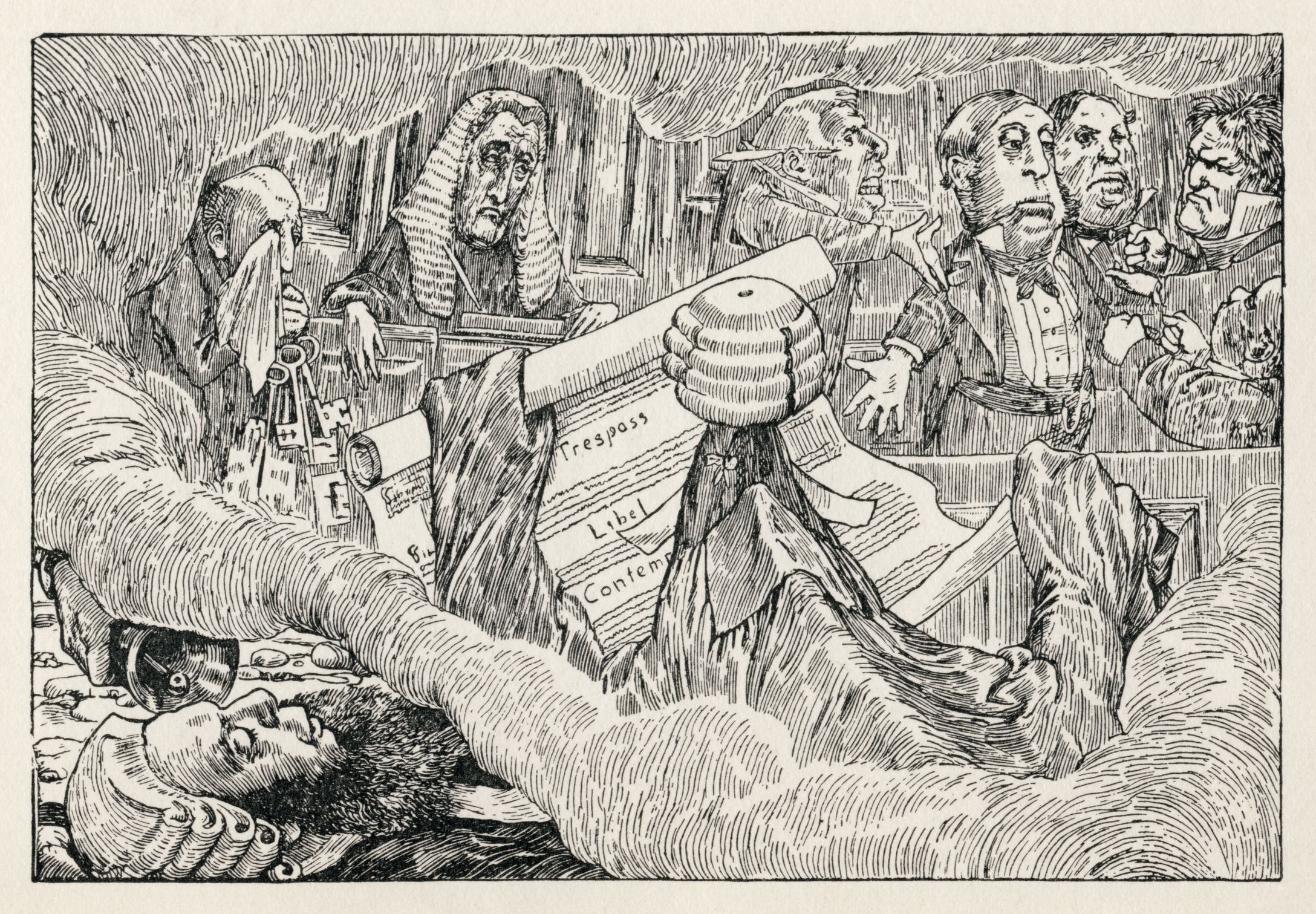
That is the portrait. Nine illustrations accompany a poem about hunting a creature, and the creature appears once: in somebody else’s dream, in a wig and gown, holding a brief, defending a pig on a charge of deserting its sty. Carroll’s own lines put it there — the Snark, with a glass in its eye, / Dressed in gown, bands, and wig
, in Fit the Sixth — and Holiday drew it as drapery. There is a wig, there is a hand, there is cloth. There is no animal.
There is a reason the Snark is barely drawn, and Holiday gave it twenty-two years later. Carroll had died twelve days before he wrote it.
One of the first three I had to do was the disappearance of the Baker, and I not unnaturally invented a Boojum. Mr. Dodgson wrote that it was a delightful monster, but that it was inadmissible. All his descriptions of the Boojum were quite unimaginable, and he wanted the creature to remain so. I assented, of course, though reluctant to dismiss what I am still confident is an accurate representation. I hope that some future Darwin, in a new Beagle, will find the beast, or its remains; if he does, I know he will confirm my drawing.
“A delightful monster, but… inadmissible” is the whole thing in five words, and it is not a judgement on the drawing. Carroll liked it. He refused it anyway, because a picture of the Boojum would have answered a question the poem is built not to answer. All his descriptions of the Boojum were quite unimaginable, and he wanted the creature to remain so
— the emptiness was not an accident of the writing. It was maintained, against a good drawing, by the author, on purpose.
Which makes the Ocean-Chart and this refusal the same editorial act performed twice. A map with the land left off, and a beast nobody is allowed to see. Carroll was protecting the empty square, ninety-three years before Deleuze had a name for it.
And Holiday never accepted it. He kept the drawing, he says here that he is still confident
it is accurate, and he hopes a future Darwin will find the animal and vindicate him. That is a man insisting, in print, that the empty word has a referent after all — and it is exactly the argument that gets made about every new term for a way of being a person, by people on both sides of it.
So the reader who wants to know what the five unmistakable marks are marks of gets a costume, in a dream, at second hand. The definition arrived four Fits earlier and the thing itself never does.
That is exactly what a new word looks like from outside. Before you have had the experience a term names, the term arrives as a list of marks recited by somebody who says they can tell. Which is the entire case against labels, put more sharply by Carroll in 1876 than by most people making it now: the marks came first, the beast is unverified, and here is a crew sailing off to find something the description brought into being.
Except that the crew does find it, in the only way that matters — the hunt happens, the Baker meets it, the poem is over. And the sheet before this one on the plate, Sheet No. 2, is about the other side of that: a word arrived at, tried on, and found to fit after a lifetime of looking. The question this sheet asks is the one before it. Not does the label fit me but where did the label come from, and what did it have to be in order to be sayable at all?
The link is Deleuze’s, not ours Link to this section
Helen proposed this sheet with a warning attached — that the Deleuze–Carroll connection may be a stretch
. It is not a stretch, and the reason is worth putting first, because it is the kind of thing that gets asserted on the internet and then turns out to be somebody’s summary. Deleuze makes the identification himself, in one sentence, in the third series of Logique du sens.
He has spent that series arguing that a proposition has three dimensions — what it points at, who is speaking, and the system of meanings that lets it refer at all — and that all three lean on each other in a circle. Sense is his name for a fourth thing that is not any of them. Then he stops and admits what looking for it is like:
l’essai de faire apparaître cette quatrième dimension est un peu comme la chasse au Snark de Lewis Carroll. Peut-être est-elle cette chasse elle-même, et le sens est le Snark.
Trying to make this fourth dimension appear is rather like Lewis Carroll’s hunting of the Snark. Perhaps it is that hunt, and sense is the Snark.
Two things follow. The first is that a philosopher usually filed under difficulty reached for a nonsense poem to say what he meant, and did it in the middle of the argument rather than in a footnote. The second is duller and matters more here: we did not put these two in a room together. The pairing is in the primary, and it took reading the primary to know that. A summary would have told us Deleuze discusses Carroll, which is true of half a book and would have left the sheet resting on our own taste.
A place with no occupant Link to this section
The mechanism is in the eighth series, where Deleuze takes up a paradox he credits to Claude Lévi-Strauss. Given two series — one of signifiers, one of things signified — there is always too much of the first and not enough of the second. Something is left over. Lévi-Strauss had a name for the leftover, and Deleuze quotes him:
un signifiant flottant, qui est la servitude de toute pensée finie, mais aussi le gage de tout art, toute poésie, toute invention mythique et esthétique
a floating signifier, which is the servitude of all finite thought, but also the pledge of all art, all poetry, every mythic and aesthetic invention.
toute révolution to the list. The words are Lévi-Strauss’s, from his 1950 introduction to the work of Marcel Mauss, which we have not read — so this is a quotation at one remove, and the English is ours.The examples Lévi-Strauss gives, as Deleuze lists them, are the words a language keeps for whatever it has not got a word for: truc, machin — thingummy, whatsit — quelque chose, the Latin aliquid, and the famous mana. A value, in Lévi-Strauss’s words as Deleuze prints them, en elle-même vide de sens et donc susceptible de recevoir n’importe quel sens, dont l’unique fonction est de combler un écart entre le signifiant et le signifié
— in itself empty of sense and therefore able to take on any sense at all, whose only job is to close a gap between signifier and signified.
Deleuze then gives the leftover his own name, and it is the one this sheet is drawn from:
Car ce qui est en excès dans la série signifiante, c’est littéralement une case vide, une place sans occupant, qui se déplace toujours ; et ce qui est en défaut dans la série signifiée, c’est un donné surnuméraire et non placé, non connu, occupant sans place et toujours déplacé.
For what is in excess in the signifying series is literally an empty square, a place with no occupant, which is always being displaced; and what is lacking in the signified series is a surplus given thing, unplaced and unknown, an occupant with no place, and always displaced.
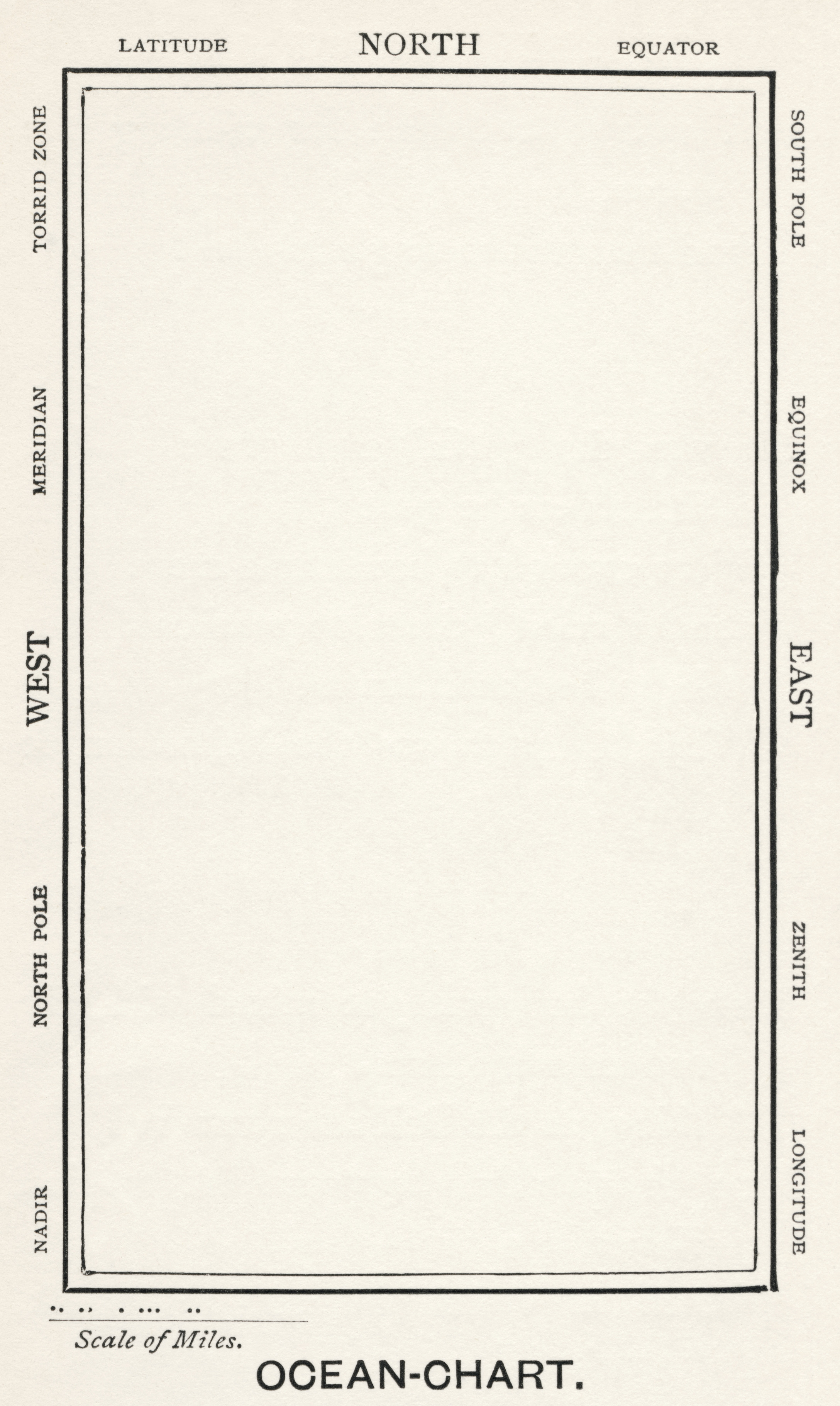
Holiday drew the empty square in 1876, and Carroll's crew are grateful for it. Every term of reference a chart can carry is present — latitude, longitude, meridian, equator, the poles, the zenith, the nadir, a Scale of Miles that is five dots — and all of it is arranged around the outside of a rule with nothing inside. This is the object the Bellman bought:
“Other maps are such shapes, with their islands and capes!But we’ve got our brave Captain to thank:”(So the crew would protest) “that he’s bought us the best—A perfect and absolute blank!”
Equally useful everywhere
is the joke, and it is also the specification. A chart with an island on it is a chart for one ocean; a chart with nothing on it will do for any of them. The blank is not a failure of the map. It is what makes the map portable, which is the argument this sheet has been making about words, drawn as an object, ninety-three years before Deleuze named it and a hundred and thirty before anybody needed a word for a way of having a brain that the available words had no room for.
An empty square is not a hole in the structure. It is the part that lets the structure move. A place with no occupant can go anywhere, which is why the same word can be reached for by people whose experiences have almost nothing in common, and why it keeps working while it travels. A word that already meant something precise could not have taken the new thing. That is not a defect in the new word. It is the specification.
Carroll’s own theory of coining, and Deleuze refusing it Link to this section
Carroll did not leave the question of where words come from to his readers. He answered it in the preface to this very poem, crediting the answer to one of his own characters:
Humpty-Dumpty’s theory, of two meanings packed into one word like a portmanteau, seems to me the right explanation for all.
If your thoughts incline ever so little towards “fuming,” you will say “fuming-furious;” if they turn, by even a hair’s breadth, towards “furious,” you will say “furious-fuming;” but if you have the rarest of gifts, a perfectly balanced mind, you will say “frumious.”
A coinage, on this account, is not a decision. It is what comes out when two words are held in the mouth at once and neither wins. Frumious is the residue of an unresolved intention, and Carroll’s name for the faculty that produces it is a perfectly balanced mind
. That is a better description of how autigender or neuroqueer got made than most accounts written since, and it comes with a warning inside it: the word arrives before you can say precisely what it means, because being unable to choose is the condition that made it.
Deleuze reads the same poem and will not let the portmanteau be the answer:
Snark est un mot-valise, qui ne désigne qu’un animal fantastique ou composite : shark + snake, requin + serpent. Mais ce n’est un mot-valise que secondairement ou accessoirement, car sa teneur comme tel ne coïncide pas avec sa fonction comme mot ésotérique.
Snark is a portmanteau word, designating no more than a fantastical or composite animal: shark + snake. But it is a portmanteau word only secondarily, incidentally — because what it holds as one does not coincide with what it does as an esoteric word.
The distinction is the useful part and it is easy to flatten. Deleuze grants that Snark packs two animals together, and then says that this is not what the word is for. Its work is to connote two series at once — one about a creature you could point at, one about a sense you could not — and the packing is incidental to that. Which is to say: a coinage is not explained by its etymology. Knowing that neuroqueer is neuro plus queer tells you almost nothing about what it does.
And then the etymology itself turns out to be contested, which is nearly too neat. Deleuze says shark plus snake. Brady, reading Deleuze, suggests instead an antiquated verb to snark, meaning to snort — a sudden short exhalation. Carroll said neither. He explained frumious and left Snark alone. So the empty word gets an origin story from whoever is carrying it, and the two origin stories do not agree, and this is a sheet about exactly that.
One more desire, with no place in the series Link to this section
The passage Helen sent, and the reason this sheet exists, is Brady’s own. He is explaining what happens when desire sits on the signified side of the pair — when the thing being reached for is the part that runs short:
Because of the indeterminacy of desire — it’s always possible that there be one more desire one has never encountered, that has no place in the ordinary series of “desires denoted by human conduct”. When desire sits on the signified side, there is always an element of it that cannot be spoken of, symbolized, or placed, which creates the impression of infinity that allows us to believe, jokingly, for a moment, that any collection of objects bought from a supermarket are being bought to be placed into a blender together by a single outrageous desire.
There is always one more. Whatever list of desires, of genders, of ways of attending, of ways of being in a body a language has got, it is possible that the next person has one that is not on it — and it is not merely possible, it is guaranteed by how the two series are shaped. The signified side runs short. Something arrives with no place to be put.
Which is where a coinage comes from, and the list of them on this site is a list of exactly that event. Autigender, for a relationship to gender that runs through being Autistic. Monotropism, for attention pooled in one deep channel rather than spread thin. Neuroqueer, first as a verb. Predominant neurotype, because neurotypical was doing a job it was not built for. Pervasive Drive for Autonomy, because the P in PDA stood for pathological and the people it described did not agree. Every one of them is a word made at the point where the ordinary series had no slot — and every one of them is, at the moment of coining, a Snark: a term whose marks can be recited before anybody can point at the thing.
This is also the honest answer to the objection that these words are invented. Of course they are invented. That is what a word is. The question is never whether a term was made up; it is whether the thing it was made up for is real, and who gets to say.
The bill, and who it lands on Link to this section
Here is the cost, and it is the reason this sheet is on this site rather than in a philosophy journal. An empty word travels faster than a full one, and what gets dropped in transit is the person who made it.
Neurodivergent was coined by Kassiane Asasumasu, in the 2000s. The word is now in policy documents, in clinical papers, in corporate diversity training, and in the first sentence of a great many talks. She has had to publish a post headed PSA from the actual coiner of “neurodivergent” — which is a thing nobody should have to write about their own word. It opens: Yo. Many of you need to take an entire stadium of seats.
I coined neurodivergent before tumblr was even a thing, like a decade or more ago, because people were using ‘neurodiverse’ and ‘neurodiversity’ to just mean autistic, & possibly LDs. But there’s more, like way more, ways a person can have a different yet fucking perfect dammit brain.
Neurodivergent refers to neurologically divergent from typical. That’s ALL.
Neurodivergent K of Radical Neurodivergence Speaking. Undated on the page — Tumblr shows only a relative timestamp, which read
Posted 11 years agoon 10 September 2026. Her capitalisation, her ampersand, and her emphasis.
That is a coinage explained by its coiner as an act of widening, and the reason is the one this sheet has been building towards. The words in use covered part of the ground — Autistic people, and perhaps people with learning disabilities — and there were way more, ways a person can have a different
brain than those words had room for. The series ran short. So she made a term with nothing in the middle of it: neurologically divergent from typical. That’s ALL.
Not a description of a kind of person. A place with no occupant.
And she is explicit that the emptiness is the specification rather than a side effect:
That is all it means. It is not another damn tool of exclusion. It is specifically a tool of inclusion. If you don’t want to be associated with Those People, then YOU are the one who needs another word. Neurodivergent is for all of us.
or no specific diagnosis but wonky lateralization or something.
Neurodivergent is for all of us
is the empty square defended by the person who cut it. Deleuze says a place with no occupant is what lets a structure move; she says, in a Tumblr post, that a word which will not exclude is the point of having made it, and that anybody who wants the word to sort people needs another word
. Those are the same claim, and hers came with an instruction attached.
That is also the Snark’s real price. The word works because there is nothing in the middle of it; anybody can carry it anywhere, which is the whole utility, and it is why the word reached the policy documents at all. But the space in the middle where the beast should be is the same space her name should be in. The emptiness that makes a coinage portable is the emptiness the credit falls out of — and a post beginning Yo
and ending Annoyedly yours
is what it costs somebody to put the name back.
The counter-practice is unglamorous and consists entirely of saying names. Helen’s own neuro-affirming glossary does it as a matter of course — intersectionality credited to Kimberlé Crenshaw, predominant neurotype to Luke Beardon, Pervasive Drive for Autonomy to Tomlin Wildling, and Asasumasu cited in the reference list for the word the whole document is built on. It is not a flourish. It is the only thing that stops a coinage becoming ownerless, and it has to be done every time, because the word will keep moving whether or not the name goes with it.
I originally conceived of neuroqueer as a verb: neuroqueering as the practice of queering (subverting, defying, disrupting, liberating oneself from) neuronormativity and heteronormativity simultaneously.
I originally conceived
is a coiner writing down the coining while he still can. Note what he preserves: not the meaning of the word, but the fact that it started as a verb and only later became something a person could be. That is a provenance note on a word, kept by the person best placed to keep it, and it is the only reason anybody can now say the adjective came second.
This site is holding a borrowed coinage Link to this section
A sheet arguing that coinages get separated from their coiners had better show its own working, and ours is not clean. The two words at the top of this site are a case in point.
The masthead of Queering Earth reads Post-normal possibilities. Helen wrote the phrase in the founding brainstorm for this project and may well have arrived at it herself. It is also, one hyphen apart, the end of the subtitle of Nick Walker’s Neuroqueer Heresies — Notes on the Neurodiversity Paradigm, Autistic Empowerment, and Postnormal Possibilities — on a site that quotes Walker on its home page, about the subject of his book. Post-normal has a third lineage too, in the post-normal science of Funtowicz and Ravetz in the early 1990s, which nobody here has yet read in the primary.
So the home page says it out loud, in the section where Walker is already quoted. Not his phrase, which would take the coinage off Helen; not silence, which was the state it shipped in and which our own decisions file was busy asserting carried no risk. The credit is written to be true about the one thing anybody can establish — that he published it first — and to claim nothing about how the phrase reached us, which nobody can honestly claim in either direction.
For six days it was also on the masthead, as a second line reading after Nick Walker. Three words under a tagline cannot carry a sentence that long, and readers supplied the missing half themselves — one read it as a death notice, one as an endorsement, one as a declaration that the whole site runs on one man’s theory, which is the opposite of what a cabinet of many lenses is for. The credit did not shrink when the line came off; it went back to the place that had room to say it properly.
That is what an honest attribution looks like when two people may have made the same word: not an arbitration, and not a shrug. The full account is in the ledger, where it was logged the day it was found.
In the midst of the word Link to this section
The poem ends with the Baker finding what the crew came for, and the finding costs him everything, mid-syllable:
In the midst of the word he was trying to say,In the midst of his laughter and glee,He had softly and suddenly vanished away—For the Snark was a Boojum, you see.
Read as a joke about metaphysics, which is how Deleuze reads it, the vanishing is what happens when you finally corner sense: it is not there to be had, and the hunt was the thing. Read from this site, on a sheet about coining, the last line is harder. Somebody disappears in the middle of the word they were trying to say, and the word carries on without them.
One more thing about that line, and it changes the order of everything above.
The real origin of The Hunting of the Snark is very singular. Mr. Dodgson was walking alone one evening, when the words, “For the Snark was a Boojum, you see,” came spontaneously into his head, and the poem was written up to them.
The last line came first. Before there was a Bellman, or a crew, or five unmistakable marks, or a blank chart, or a Baker with forty-two boxes, there was one sentence containing a word that meant nothing, arriving unbidden in the head of a man out walking. Everything else was built backwards to arrive at it.
So the poem is not a hunt that ends in a word. It is a word that had a hunt built around it — which is the truest thing on this sheet about how any of this works. Neurodivergent came to Kassiane Asasumasu because the words in use had no room for more ways of having a brain; the definitions, the papers, the policy documents and the arguments were all written up to it afterwards. The word arrives first and the structure assembles itself around the vacancy. Carroll did it on a walk one evening, and then built eight fits to get back to it.
The register at the back of this cabinet exists because that is not inevitable. A quotation gets read in the work it came from. A coinage gets its coiner’s name beside it. A correction gets logged where a reader can find it, in gold, because the mend is the valuable part. None of that is difficult. It is only work that has to be done every single time, and the alternative is a shelf full of warranted genuine Snarks and nobody left to say where any of them came from.
What this sheet will not tidy
- We have not read The Logic of Sense in English. Ryan does not have it and it is not sold as an ebook; the Minuit French was reachable and the Lester translation was not. So every English rendering of Deleuze here is ours, labelled as a gloss rather than a translation, on the same principle as the wyrd half-line on Sheet No. 4. Quoting Lester’s English through somebody’s summary would have put a translator’s authored choices in Deleuze’s mouth at a page number we could not open. If you have the English, the page numbers here will not match yours — ours are the French.
- The scan is somebody’s marked-up copy and its printing is unstated. Every page number above was read off the page image rather than a text layer, because the optical transcription of this scan is visibly lossy — it drops accents and breaks words across lines. The pages are 31, 60, 64 and 65 in the copy we read, and the running heads confirm the series. A different printing may repaginate.
- Lévi-Strauss is quoted at one remove and that is a real weakness. His words reached us inside Deleuze’s book. The primary is his 1950 introduction to the work of Marcel Mauss, which has not been read here, so the floating signifier is credited to him on Deleuze’s authority and not on ours.
- One sentence of Carroll’s preface is quoted around rather than through. Project Gutenberg’s transcription reads
leave it unsettled which you will first
, which appears to want a word. We do not know whether the gap is Carroll’s or the transcriber’s, and repairing somebody’s sentence to make it read better is the exact failure this cabinet is organised against — so the quotation starts after it. - The veto is now quoted from the primary, and the version in circulation drops three words that change it. Secondary accounts have Carroll rejecting the drawing as
inadmissible
, which reads as distaste. What Holiday actually wrote is that Carroll called ita delightful monster, but… inadmissible
. He liked it and refused it anyway, which is a different act and a better one for this sheet. Read off the page images because that scan’s text layer mangles this passage in particular — it rendersMr. Dodgson
asMr. ey
and losesdelightful monster
entirely, so an automated read of the primary would have reproduced the secondary version’s error by a different route. - Anne Clark’s biography is still unread here. Wikipedia credits the veto to it, pp. 196–97. Nothing on this sheet now depends on that citation, since Holiday’s own account covers it, but the two have not been compared.
- The drawing Carroll refused is said to have been published in 1932 and we cannot show it. It is not on Wikimedia Commons and no public-domain copy was found. Holiday kept it and hoped a future Darwin would vindicate him; on a sheet about a creature nobody is allowed to see, the unavailability of the one picture of it is either very funny or the whole point, and it is not an oversight.
- Both plates are 1876 engravings scanned from a 1931 printing, which is why the captions carry two dates. The stored copies here are 2,176 px wide rather than the 3,540 and 5,184 px of the Commons masters — the masters are 4.9 and 8.3 MB, and an
imgfallback that size is the one image path nosrcsetprotects. The full-resolution files stay at Commons and the captions link to them. - Applying an empty square to a community’s neologisms is our extension, not Deleuze’s claim. He is writing about structure and sense; the argument that the same emptiness is what strips a coiner’s name off her coinage is ours, and he cannot be cited for it. It is the load-bearing move on this sheet and it is the one with the least support behind it.
- The post is signed Neurodivergent K, not Kassiane Asasumasu. It was read in place on 10 September 2026 and is quoted above from that reading. The identification of the blog with her name is not ours: it comes from the reference list of Helen’s glossary, which cites Asasumasu, K. at exactly this address. Tumblr shows no absolute date, only
Posted 11 years ago
, so the post is cited undated with the timestamp and the reading date recorded rather than a year inferred from them. Her own dating of the coinage is her sentence, not our arithmetic.
Queering Earth Sheet No. 9 Accessioned
Provenance Mounted . Re-determined once, when the masthead credit came off and the account of it on this sheet stopped being true.