Sheet · an essay
My Gloomy Sunflowers
Content warning — in brief
- Suicide
- Depression
- Psychiatric coercion
- Chronic pain
- Opioid use
- Domestic violence
- Rape
- Sexual violence against a child
Keywords first, so the decision can be made without reading the detail. The full version names specifics, including the real case behind one of the songs; open it only if you want them. Crisis lines are at the foot of the sheet.
Content warning in full
This sheet is about four artists who were very ill and who mostly did not survive it. It carries suicide — three of the four died by it, and the fourth of alcoholism — depression and psychiatric crisis, coercive psychiatric treatment including insulin coma therapy and electroshock given to two twenty-year-olds, chronic pain and opioid use, and domestic violence.
It also carries the abduction, rape and torture of a fourteen-year-old girl — the 1987 case behind Nirvana’s Polly
— and an account, in Kurt Cobain’s own words, of two men raping a girl while singing that song. Both are discussed in the last of the four sections, and the song itself is embedded there.
No method of suicide is described anywhere on this sheet, and no death is presented as an ending the work was building towards. If you want the argument without the case histories, the first section and the last carry it between them.
- Written by
- Ryan Boren
- Read
- Townes Van Zandt, Vincent van Gogh, Sylvia Plath, Kurt Cobain
- Copies read
- Robert Earl Hardy, A Deeper Blue (University of North Texas Press, 2008) · The Letters of Vincent van Gogh, the Van Gogh Museum and Huygens Institute edition at vangoghletters.org · The Unabridged Journals of Sylvia Plath, ed. Karen V. Kukil (Anchor, 2000) · Michael Azerrad, Come As You Are (Doubleday, 1993) · the Incesticide sleeve
- Also read
- Hannah Gadsby, Nanette (2018) · Shoshana Kessock, Falling/Burning (2018)
I have spent years with four artists, usually together: a van Gogh open on the screen, Plath in my hands, Townes Van Zandt and Kurt Cobain in my ears. They help me process what a writer about Townes once called the immense ache of this world.
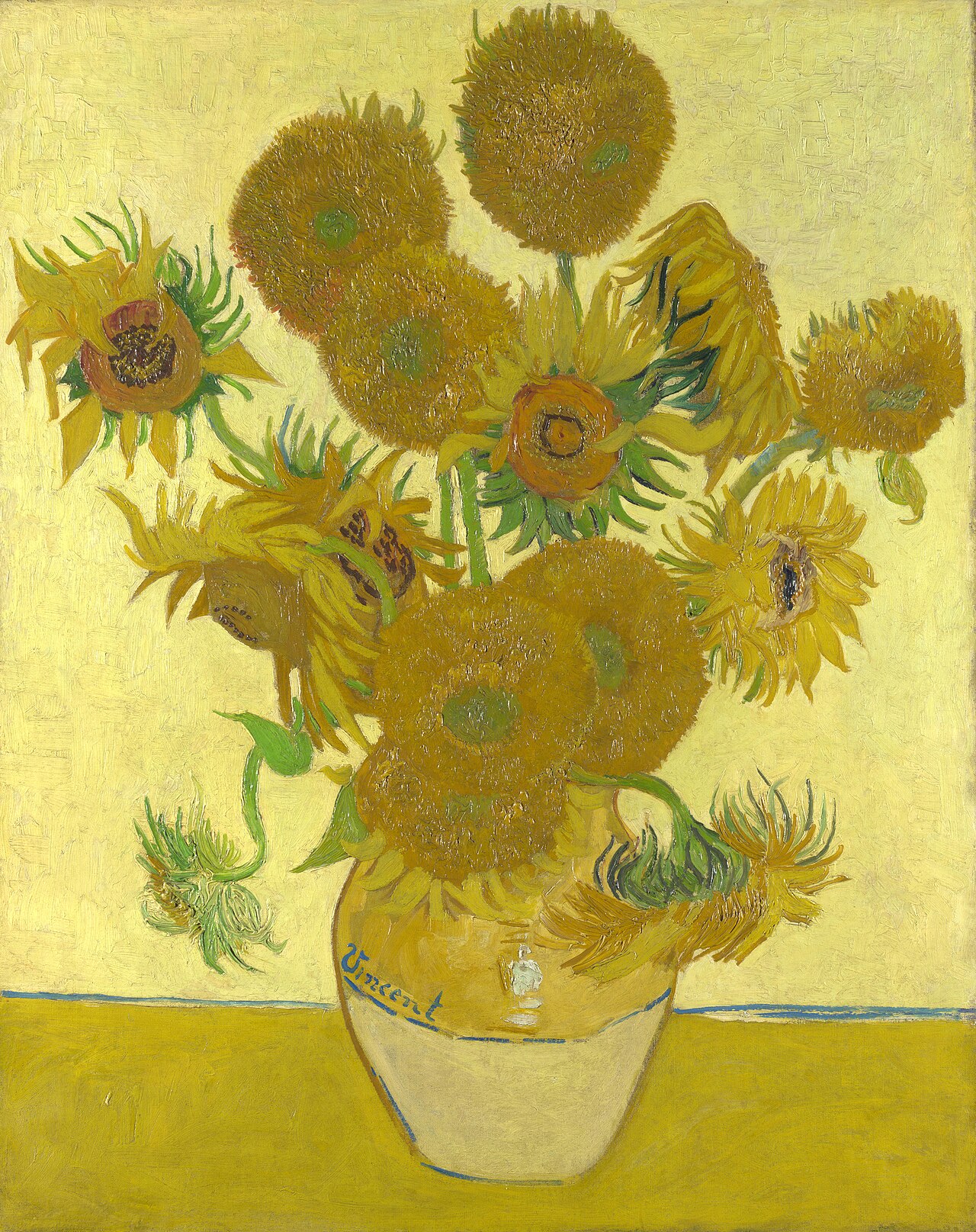
They are my gloomy sunflowers. All four are sold to me, and have been my whole life, as proof of one idea — that the pain is where the work came from. The pain is real and it is in the work. I am not going to pretend otherwise; it is audible and it is visible and it is a large part of why I keep going back to them. What I have stopped believing is the arrow. Not that they suffered — that the suffering is what made the work possible, that it was the price of it, that it was somehow the necessary cost of being that good. This sheet is the reading that moved me off that, and four records that do not support the bargain.
The tether Link to this section
Hannah Gadsby, at the end of Nanette, on the painter everybody reaches for first:
Do you know why we have the sunflowers? It’s not because Vincent van Gogh suffered. It’s because Vincent van Gogh had a brother who loved him. Through all the pain, he had a tether, a connection to the world. And that is the focus of the story we need. Connection.
Shoshana Kessock, a writer and game designer with bipolar II, watched the same special and wrote the essay this sheet leans on hardest. She published it on her own site in July 2018, under a title that names the thing exactly — Falling/Burning: Hannah Gadsby, Nanette, and the Myth of the Mad Artist — and it was collected in Alice Wong’s Disability Visibility two years later. She describes her own working days, the good ones and the ones where the words would not come, and then this:
Hannah Gadsby told people artists don’t have to suffer for their art, and I’ll forever thank her for having the guts to stand up and say that to the world. Because I used to believe it was true.
Because I used to believe it was true. So did I. That is the sentence this sheet is written out of, and it is worth saying plainly that it is hers and not ours — she is a Disabled writer whose byline has more than once been absorbed into the anthology’s title, including, until recently, on our own sister site.
What the four do not share
The tidy version of this sheet says: four artists, one diagnosis, one lesson. That version does not survive the sources, and the mess is more interesting than the tidiness.
- Townes Van Zandt has a contemporaneous clinical record, and it does not say manic depression. The Galveston file of 1964 reads
Schizophrenic reaction, Schizo-affective type (Depression)
. - Vincent van Gogh has the most careful retrospective diagnosis anybody has managed — and its own authors hedge it: a
(probably bipolar) mood disorder
with borderline traits, alcohol use disorder and malnutrition. It was reached by administering a structured psychiatric interview to three art historians. - Sylvia Plath has a psychiatrist arguing the opposite in print: recurrent depressive disorder, in the context of borderline personality disorder, and explicitly not manic-depressive illness.
- Kurt Cobain has a childhood diagnosis of hyperactivity, and, for anything else, his own passing self-description. The word
bipolar
does not appear in the biography he cooperated with.
Four artists the internet files under one label, and the evidence runs from a signed clinical note to a recollection to a peer-reviewed paper flatly refusing the label. What they actually share is not a diagnosis. It is having been treated as one, and read afterwards as one.
And that is the part this cabinet exists for. Retrospective diagnosis is a genre, and it has a politics. Four dead people, none of whom consented, their inner lives argued over in journals by people who never met them, and the conclusions used to explain the work. I am going to use that literature, because it is careful and because ignoring it would be its own kind of dishonesty. I am also going to say what it is.
Two rooms, nine years apart Link to this section
Sylvia Plath was born on 27 October 1932. In September 1953, after a suicide attempt in August and a course of unmodified electroconvulsive therapy — no anaesthetic, no muscle relaxant — she was admitted to McLean Hospital, where her treatment included insulin. She was twenty.
John Townes Van Zandt was born on 7 March 1944. On 14 March 1964 his parents drove him from Houston to Galveston and admitted him to the Titus Harris Clinic at the University of Texas Medical Branch, where he was given insulin coma therapy and electroshock, about forty treatments between early April and early June. He had turned twenty seven days earlier.
They never met. They shared a decade, a continent, a treatment, and an age. Both afterwards wrote about being emptied out, and one of them could not afterwards remember his own childhood.
I want to be careful here, because the neat version is available and it is not quite true. Insulin coma therapy was not a punishment and the people administering it were not villains; it was the best thing the profession thought it had, and Hardy is scrupulous about that. But it was done to two twenty-year-olds who were, between them, going to write Ariel and Waitin’ Around to Die, and the profession has never quite reckoned with how confidently it was wrong.
Galveston, 1964 Link to this section
Almost everything on the internet about this is wrong, and I was repeating most of it a week ago. The usual version: 1962 or 1963, three months of insulin shock, a diagnosis of manic depression, and a treatment that erased his childhood. Hardy’s biography — the documented one — has a different file.
The psychological report found an obsessive-compulsive schizoid character with strong paranoid trends.
The official diagnosis was Schizophrenic reaction, Schizo-affective type (Depression).
And the report explains its reasoning. He felt inadequate beside a successful father, and:
there are indications of some feminine elements in his character structure and these feminine elements threaten his whole value system, sense of self, and adequacy as a male.
Read that again, because it is the reason this sheet exists on this site and not another one. A Texas clinic in 1964 looked at a gentle, sensitive, artistic teenager, found femininity in him, classed it as a threat to his adequacy as a male, filed it under a schizophrenic potential, and then treated it about forty times with insulin and electricity.
Nobody has to queer this document. It queers itself. It is an institution writing down, in clinical register and without embarrassment, that the problem with this young man is that he is not manly enough — and then doing something about it.
Not everybody in the building agreed. His first wife, Fran Petters, met one of his young doctors months later:
he actually quit psychiatry because of Townes’ case. He said, ‘I didn’t think there was anything really wrong with him. I did not agree with the treatment.’
The sentence that got quoted, and the one that got written down
Two years later, with Vietnam escalating, Townes went to a recruiter to join the Army and needed a psychiatric clearance he did not get. The letter they wrote instead is the most quoted thing about his illness, and it exists in two versions from one witness.
In Hardy’s main text, Fran Petters recalls a letter saying he was an acute schizophrenic and was only marginally adapting to life.
In Hardy’s endnote, recording a Texas Monthly piece of March 1998, the same woman recalls the doctors calling him an acute manic-depressive who has made minimal adjustments to life.
One witness, three decades apart, two wordings, two different illnesses. Hardy printed both and footnoted the discrepancy instead of choosing the better line. The internet chose. It took the 1998 version, because it scans better, and that is now the sentence everybody knows — including, until this week, me.
There is a whole argument about attribution sitting in that, and this cabinet keeps a ledger because of it. But the thing I keep returning to is smaller. A man was told, on paper, by a doctor, what he was. He read it and said, I’m crazy.
Fran told him no, it was just making him 4-F. And the same doctor, in the same letter, wrote that Townes should be allowed to wander and find himself — which is the one piece of advice in this entire file that sounds like it was addressed to a person.
The childhood he could not get back
Fran again: He virtually had no memory of his childhood.
His mother went through the family photograph albums with him, over and over, telling him the stories, trying to rebuild it — and what came back was not quite memory:
It was like rote memory, not a picture memory. I think it started coming back over time, but he never trusted that it was a real memory.
Hardy will not close the loop, and I am not going to close it for him. A doctor at the same hospital told him that electroshock causes short-term loss but that wiping out blocks of childhood is not the result of such treatment
, and offered alcoholism as an alternative explanation; other people close to Townes thought he was exaggerating it to work on his parents. The clean story — the treatment took his childhood — is the one thing the careful biography declines to assert. I want it to be true because it is a better sentence. That is exactly why I should not have it.
The blacksmith in the kitchen
There is one more document from this part of his life, and it is the only place on this sheet where you can watch the argument happen rather than read about it.
In 1975 James Szalapski filmed Townes at home outside Nashville for Heartworn Highways. Sitting on a stool in the kitchen is Uncle Seymour Washington, a retired blacksmith and a neighbour. Townes plays him Waitin’ Around to Die
— the bleakest song in his catalogue, and the one usually offered as proof of everything this sheet is arguing against — and partway through, Uncle Seymour begins to cry, and somebody comforts him.
Waitin’ Around to Die, filmed 1975 for Heartworn Highways (dir. James Szalapski, released 1981). Posted by Light in the Attic Records, who reissued the film.
That is the whole thesis in ninety seconds, and nobody had to write it down. The song is not doing what the myth says songs like this do. It is not a symptom being displayed. It is one man singing to another man in a kitchen, and the other man is moved, and that is what the song was for. Uncle Seymour is not weeping at a diagnosis. He is weeping because somebody found words for something and handed them over.
The song is a life told in five verses — a father who beat a mother, a girl in a Tuscaloosa bar, a robbery, two years inside — and it arrives here:
Ah, but now, I’m out of prison, I got me a friend at lastHe don’t drink or steal or cheat or lieAh his name is Codeine, he’s the nicest thing I’ve seen
Waitin’ Around to Die, fifth verse, less its closing refrain. Recorded for For the Sake of the Song (Poppy, 1968) and performed in the film above.
The whole song is a search for a tether, and it ends by finding the wrong one. Every verse is somebody leaving, and the last one is a man who has finally got a friend who will not let him down, and the friend is a drug. That is the bleakest joke Townes ever wrote and it is why the song is Exhibit A for the version of him I am arguing against.
But look at what is actually in the room. The man in the song has nobody. The man listening to it has somebody — he is sitting in the kitchen of the person singing to him, and he is allowed to cry there. The song is the case for despair and the scene around it is the refutation, in the same ninety seconds.
One more thing, because it comes back in Kurt’s section: the narrator is not Townes. He never went to prison. It is a character, written in a first person that is not his, by a man of twenty-four — and it has been read as autobiography for sixty years, because a first person in a song is almost always taken as a confession. Hold onto that.
The almond tree Link to this section
On 31 January 1890 Theo wrote to his brother in the asylum at Saint-Rémy to say that his son had been born, and that they had named him Vincent Willem. Vincent started a painting for the child: branches in flower, seen from below, against a blue sky. To his mother, on 19 February, he described it as large branches of white almond blossom against a blue sky.
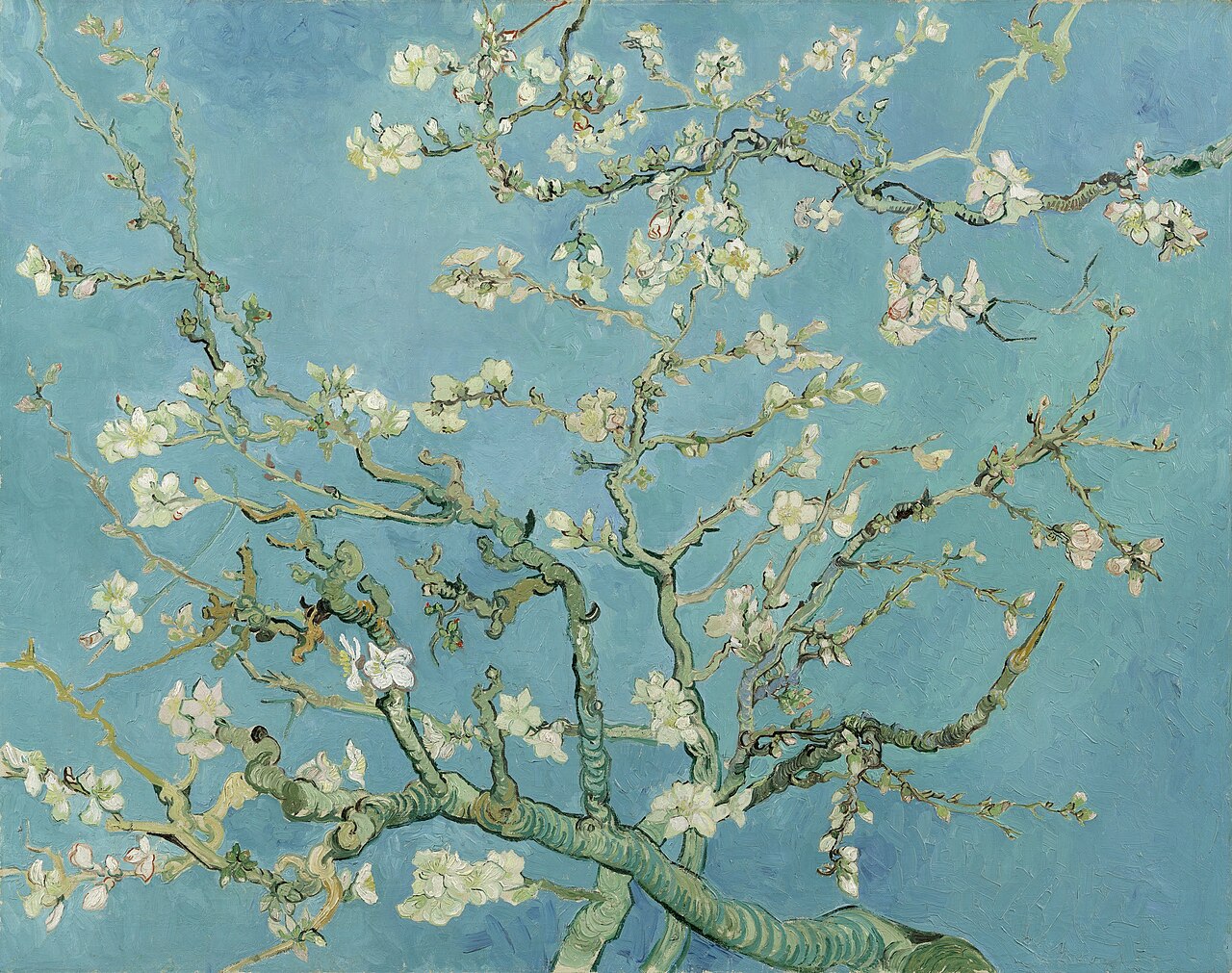
Then, in a letter to Theo of about 17 March 1890, three passages. They are in this order:
Work was going well, the last canvas of the branches in blossom, you’ll see that it was perhaps the most patiently worked, best thing I had done, painted with calm and a greater sureness of touch.
I’m picking up this letter again to try and write, it will come little by little, it’s just that my mind has been so affected – without pain, it’s true – but totally stupefied.
And so I almost or entirely despair of myself.
The myth has the arrow pointing one way. This letter points it the other. The calmest, most patiently worked thing he ever made was made for a baby, in an asylum, during a stretch when work was going well — and then the illness arrived and stopped him, and he picked the same letter back up days later to finish it as a man despairing of himself.
Painted with calm. That is his phrase, about the picture everybody treats as the exception to his agony, written in the same letter where he says his mind has been totally stupefied. He is not describing a symptom. He is describing a good run, and grieving its end.
Gadsby is right that the sunflowers are about Theo. I would add one thing to it. The almond blossom is about Theo’s son, and Vincent did not paint it because he was suffering. He painted it because a baby had been born and named after him, and for a few weeks he was well enough to work.
Two electric currents Link to this section
Sylvia Plath, in her journal, on Friday, 20 June 1958. She had finished her teaching year at Smith three weeks before and had moved to Boston to write full time:
My motto here might well be “My spirits, as in a dream, are all bound up.” I have been, and am, battling depression. It is as if my life were magically run by two electric currents: joyous positive and despairing negative – which ever is running at the moment dominates my life, floods it. I am now flooded with despair, almost hysteria, as if I were smothering. As if a great muscular owl were sitting on my chest, its talons clenching & constricting my heart. I knew this fresh life would be harder, much harder, than teaching – but I have weapons, & self-knowledge is the best of them.
“Which ever” is two words, and that is not a typing error. Kukil’s edition exists to give Plath’s journals as she wrote them, spelling and spacing included, and we have quoted this passage for years with the two words closed up into one. It is the smallest possible correction and it is the whole discipline of this cabinet: somebody, somewhere along the line, tidied a woman’s journal on her behalf. We do not do that here, and we did it anyway, and now we have stopped.
Read what the passage actually says. It is not a cry. It is a weather report, written by somebody who has been through this before and expects to again, and it ends on weapons — on self-knowledge as a tool. She is describing an illness while working, which is what almost every day of a working artist’s illness looks like and almost nothing in the myth allows for.
Five years earlier she had been twenty, in the room described above. She would write Ariel. And the poems of hers I return to most are not the ones the myth wants: Morning Song
and Nick and the Candlestick
, both written for her children, both tender, neither ever quoted at me as evidence of anything.
What she was read as
There is a thing this sheet is slower to say about Sylvia Plath than it is about Townes Van Zandt.
The 1964 Galveston file reads a young man’s gentleness as a threat to his adequacy as a male, and I said that document queers itself. Plath’s is the same argument run the other way, and it is so ordinary that it is easy to walk past. Cooper’s case-formulation — the careful one, the one that refuses manic depression — places her illness in the context of borderline personality disorder
. Set that beside the life it is describing: a woman in the 1950s who was ferociously ambitious, who wanted the work and the marriage and the children and would not choose between them, whose anger was large and whose standards for herself were merciless.
I am not competent to re-diagnose her and I am not going to try; a sheet that spent four sections objecting to retrospective diagnosis does not get to do one at the end. What I will say is what this sheet has said about the other three. A label is doing work the person did not consent to and cannot answer, and the question this cabinet exists to ask is what else it could have been.
Because none of the expectations around her were neutral, and most of them were not about illness at all. She was a woman expected to be a wife who wrote, in that order. Her husband could leave and go on being a poet; she could not leave and go on being anything. She was given unmodified electroconvulsive therapy at twenty. She had two small children and no money of her own. When she wrote to her psychiatrist about her marriage — those fourteen letters — she was describing violence to the one person who might believe her, in a decade with no word for what was happening to her and no door out of it.
Alive now, almost every line of that paragraph is different. Not the illness — the illness was real, it is still real, and people are still dying of it. But a woman writing today can leave a marriage without being ruined by it, can hold her own money, is not given unmodified ECT at twenty, and would not have her manuscript reordered after her death by the husband she had separated from, because he happened to be her executor. The illness was hers. Nearly everything arranged around it was an arrangement — and arrangements are precisely the thing this site was built to say were never inevitable.
An editor, and a sheet still to come
One more thing belongs here as a marker rather than an argument. Plath left Ariel in an order she had chosen, and it was published in an order Ted Hughes chose instead. Her manuscript ends on the bee sequence and, in Wintering, on survival. His does not.
That is an editor moving a woman’s hardest material after her death, which is the subject of Sheet No. 5 in a different century, and it deserves its own number rather than a paragraph borrowed from this one. It is coming. I am flagging it here so that nobody reads this sheet’s silence as agreement with the 1965 running order.
Hi, how are you Link to this section
Kurt Cobain is the one I had least evidence for and the most opinions about. Michael Azerrad’s Come As You Are is the only biography Cobain cooperated with, and reading it properly took most of my assumptions apart.
The word bipolar
does not occur in it. Neither does attention deficit
. What is there is a childhood diagnosis of hyperactivity, and this:
He had been diagnosed as hyperactive. Like many kids of his generation, Kurt had been given the drug Ritalin, a form of speed, which counteracts hyperactivity. It kept him up until four in the morning. Sedatives made him fall asleep in school.
What eventually worked was taking sugar and Red Dye #2 out of his diet. And he was not the only one in the band: Azerrad notes that the drummer Chad Channing had also been hyperactive and given Ritalin, and quotes Dave Grohl saying I was super-hyperactive
— adding, in brackets, although not hyper enough to get put on Ritalin.
Three of them, in one book, described as hyperactive children. A generation handed speed for the crime of being eight, and the one who got the most of it is the one we call tortured.
The body, which nobody quotes
In eighth grade Kurt was diagnosed with a minor scoliosis. He played guitar left-handed, and Azerrad records that the weight of his guitar actually made the curvature worse. If he had been right-handed, he says, it would have corrected the problem.
Then the stomach — the pain that organised his adult life, and the reason he gave for a great deal of what he did:
…nine in the first part of 1993 alone—who remain baffled as to what his problem might be. Ulcers have been ruled out. The latest theory is that a kink in Kurt’s spine due to his scoliosis is pinching a nerve which leads to his stomach. Besides opiate-derived analgesics, the only effective cure Kurt has found is performing on stage, when a massive endorphin rush kills the pain. Ironically, Kurt’s condition may have something to do with his agonized wail. Or vice versa.
Follow that chain. A left-handed boy plays a right-handed body’s instrument. The instrument deepens a curve in his spine. The curve pinches a nerve. The nerve produces a pain nine specialists cannot name. The pain is met with opiates, and with the stage, which is the only other thing that touches it. And the authorised biography raises the possibility that the most mythologised voice in rock — the sound everybody hears as anguish — is partly a pain response.
Thirty years of people calling that voice the sound of a tortured soul. It may have been the sound of a man whose back hurt.
And there is a conclusion all of this points at. Read the Azerrad passage again as a record of care rather than as a detail about a singer. Nine specialists in the first half of one year. Ulcers ruled out. No diagnosis at the end of it. A man in continuous, documented pain, and the only two things that reliably touched it were opiates and a stage.
He had no adequate pain relief, so he treated himself. That sentence is the right way round, and the usual one is backwards. The heroin is the thing everybody remembers about Kurt Cobain and it is the second thing that happened; the first is that a medical system examined a young man in pain nine times in six months and could not tell him what was wrong, and he went on hurting in the meantime. Whatever else his addiction was, it began as a person doing the only thing left to do about a pain nobody would name.
Which makes it the same shape as Plath’s, one decade over. Not people who failed to hold him — he had a wife, a daughter, a band and the attention of the world — but arrangements with no provision in them for what was actually wrong with him. You cannot be held by a system that has not worked out what it is holding.
What he did with it
Which brings me to the document I would put on the wall. The liner notes Cobain wrote for Incesticide in late 1992 open with him hunting a record: the out-of-print first Raincoats LP, a trip to Rough Trade, a hand-drawn map, and Ana da Silva found working in an antique shop, who offers to send him her own copy. He writes:
I left feeling like a dork, like I had violated her space, like she probably thought my band was tacky.
Then two columns of other people’s records and other people’s causes — Shonen Knife, the Vaselines reformed in Edinburgh, the Melvins, the Wipers, Mudhoney, Calamity Jane, the Breeders, the Jesus Lizard, benefits for abortion access in Los Angeles — and, dropped into the middle of the list, kissing Chris and Dave on Saturday Night Live just to spite homophobes.
And then the passage everybody knows, which is almost never printed with the sentence that produces it:
Last year, a girl was raped by two wastes of sperm and eggs while they sang the lyrics to our song “Polly.” I have a hard time carrying on knowing there are plankton like that in our audience.
At this point I have a request for our fans. If any of you in any way hate homosexuals, people of different color, or woman, please do this one favor for us — leave us the fuck alone! Don’t come to our shows and don’t buy our records.
Mounted alone, the request is a slogan. It is not a slogan. It is the second half of a man working out, in public, on the sleeve of a record, what he owes the people his work reaches — after learning what two of them did to a woman while singing something he wrote. Cutting it loose from its reason is the kind of tidying this cabinet keeps a ledger to prevent, and it happens to this passage constantly.
The song they were singing
It is worth knowing what Polly
actually is, because the liner note only works if you do.
In August 1987 a fourteen-year-old girl leaving a concert in Tacoma was abducted by a man named Gerald Arthur Friend, who suspended her from a pulley in his mobile home and raped and tortured her. She escaped by jumping from his truck at a filling station. Cobain read about the case and wrote a song about it — in the abductor’s voice, first person, without editorial, so that a listener has no position to occupy except his. It is on Nevermind, and he wrote it alone.
Polly, from Nevermind (DGC, 1991). Official audio, posted by the rightsholder.
Then two men sang it while raping a girl. That is the sentence in the liner notes above, and this is what it means: Cobain wrote a first-person account of a rapist in order to make the position unbearable, and two members of his audience heard the same words as a soundtrack. They did not misunderstand a difficult metaphor. They took a voice the songwriter had put on in horror and wore it in earnest.
He said afterwards that the thing that actually needs doing is teaching men not to rape.
It is the least ambiguous sentence in this entire sheet and it is thirty-five years old.
I have deliberately quoted no words from this song, and Townes’ is quoted three sections up, so the difference is worth stating. It is not that the words were hard to check. Every word of Polly
is spoken by the man who did it — that is the whole construction of the song, and it is why it works. Setting those words on this paper, in the display face, inside a ruled box with a herbarium label pinned to it, would give a rapist’s speech the exact mounting this cabinet gives to Woolf and to Plath, on the one sheet that also carries the account of two men singing them at a real girl. The recording is above, whole, in his own arrangement. That is where that voice belongs.
He signs the notes Kurdt (the blond one)
.
This is the tether, and it runs outward. The Daniel Johnston T-shirt he wore — another Disabled artist’s drawing, worn on television by the most photographed man in music — is the same gesture in one object. The liner notes are that gesture at full length, in his own prose: a famous man spending his platform on other people’s records and closing the door on the part of his audience that hates queers, women and people of colour. Connection was not something that happened to Kurt Cobain. It was something he did, repeatedly, in writing.
What else it could have been Link to this section
I went looking for four biographies and found the same sentence three times, in three archives that have nothing to do with each other.
- A 1964 clinic reads a young man’s gentleness as a symptom, and treats it forty times.
- A painter describes his best canvas as
painted with calm
, in the letter where he says his mind is stupefied — and we file the painting under the illness anyway. - A biographer suggests that the most famous anguished voice of a generation may be a man’s spine.
In every one of them the work is read as a symptom, and in every one of them the record says the work was the thing that was going well. That is not a coincidence and it is not subtle. It is what happens when a culture decides in advance that art comes out of suffering: the evidence gets sorted to fit, and the good days — which is when the work actually got made — disappear from the story.
Plath, twenty, in an insulin ward. Townes, twenty, in another one, seven days after his birthday. Vincent in Saint-Rémy painting a tree for a baby. Kurt writing a fan letter to the Raincoats on the sleeve of his own record. None of those four things is suffering producing art. All four are somebody reaching for the world, and the world occasionally reaching back.
Three of these four died by suicide. The fourth drank himself to death at fifty-two. I am not going to pretend the connections were enough, because they were not, and a sheet that ended on love saves would be lying to you in the other direction. Theo could not keep Vincent alive. Fran could not keep Townes sober. What the tether did was buy time, and in that time the work got made.
So: what else could any of it have been? A clinic that read a sensitive boy as a sensitive boy. A profession that asked Sylvia Plath what she needed instead of what was wrong with her. Nine specialists who found the nerve. An audience that heard Kurt Cobain ask, and listened. None of those is a fantasy. Every one of them was available at the time, to somebody paying attention, and in at least one case somebody was — a young doctor in Galveston who quit his profession over what was being done to a twenty-year-old, and told his wife he did not think there was anything really wrong with him.
Held, and what that word is doing
It would be easy to end this by saying they kept working for as long as somebody held the line for them. It is not true of any of them. Theo never let go; Vincent died anyway. Plath was writing at the highest rate of her life in the months she was least supported. It is a tidy sentence and it quietly blames the living — it says that when these four died, somebody had stopped holding on.
And there is something wrong with the word held itself. All four of these people were markedly self-reliant, and that is not incidental to why neurodivergent readers find them. They were not waiting to be carried. The tether in Gadsby’s line was never a rescue — Theo did not save Vincent, he wrote to him and paid for the paint.
For Plath the point is political rather than personal. It is not that the people around her put her down. It is that the structures of 1963 did not permit her to be held at all: no money of her own, no way out of a marriage that would not ruin her, a psychiatry that had already given her electricity at twenty, and a literary world that would hand her manuscript to the husband she had separated from. You cannot be held by arrangements built so that holding is unavailable.
Cobain is the same failure one decade over. He had a wife, a daughter, a band and the attention of the world, and none of that could tell him what was wrong with his stomach. Neither of them was failed by a shortage of people. They were failed by arrangements with no provision in them for what was actually wrong.
So the sentence I want is not about who held on. They endured this, at length, on their own terms, until it exceeded what a person can carry. The going was theirs.
They are still my gloomy sunflowers. I still put the painting up and the records on. What has changed is what I think I am looking at. Not four people destroyed into greatness, and not four people rescued for a while either. Four self-reliant people who worked whenever they were well enough to — far more often than the story admits — and who endured, on their own terms, until enduring became impossible. What failed them was not mostly the people. It was the arrangements, and arrangements are the thing this site was built to say were never inevitable.
If this is your weather too Link to this section
In the United States, call or text 988 for the Suicide & Crisis Lifeline. In the UK and Ireland, Samaritans are on 116 123. Elsewhere, the International Association for Suicide Prevention keeps a directory.
If you are a person who makes things and somebody has told you the pain is the point: it is not, and you are allowed to want to be well and to still be an artist afterwards. That is Gadsby’s argument and Kessock’s, and I am only the fourth or fifth person to pass it along.