Sheet · an essay
Held, Not Fixed
- Written by
- Helen Edgar
- Read by
- Helen Edgar and Ryan Boren
On lost things, wonder, and the cabinets we keep for one another. A shop where a broken object is looked at rather than mended, a herbarium sheet where one flattened plant is made to stand for every other, and a cabinet where a unicorn horn was allowed to stay wonderful after it turned out to be a whale.
What Emily brings Link to this section
Bagpuss was my absolute favourite childhood programme. I must have watched it hundreds of times, possibly thousands of times! Curled up, absorbed, comforted by its gentle rhythm and predictable storytelling, yet there was always something in each episode that was a bit different and ignited my curiosity. Looking back, it was the most perfect programme for as yet unidentified Autistic me. It was quiet and cosy and repetitive in the best kind of way. Just a small world that unfolded at its own pace, with characters who felt both strange and familiar, and stories that often began with something discarded or lost. It all felt very magical, and I wanted to live there amongst them all, forever.
For anyone unfamiliar: Bagpuss is a children’s television series made by Smallfilms — Oliver Postgate and Peter Firmin — for the BBC. Thirteen episodes were broadcast between February and May 1974, no more were ever made, and they were repeated until 1986. Each one begins in a shop where Emily, a young girl, brings in something broken or lost that she has found. She puts it down in front of Bagpuss, her saggy old cloth cat, and speaks a familiar phrase:
Bagpuss, dear Bagpuss
Old fat furry cat-puss
Wake up and look at this thing that I bring
Wake up, be bright
Be golden and light
Bagpuss, Oh hear what I sing
some magic words.
Once Bagpuss wakes up, something shifts. The whole world of the little shop comes alive with him. His friends gather in their different ways, each with their own logic, their own style of thinking, responding, and ways of being. They don’t jump to fix things, they wonder, they are inspired and curious. They turn the object over gently, looking at it from different angles, playing with stories, holding space for possibility. It felt to me like an internal unfolding, sparked into motion by something small but meaningful, some pull on my attentional thread that led to a monotropic flow we shared together.
There was no urgency in the Bagpuss programmes, no expectation to make the found objects useful again.
What the outside world calls lost or broken isn’t dismissed; it’s worthy of care, just as it is, in the way it was found.
The process isn’t about repair in the usual sense; it’s about restoration of meaning and finding different and other ways of being and perceiving that are equally valuable. Perhaps it is the kind of meaning that matters most to us as neurodivergent people, emotional meaning, sensory meaning, the kind that can’t always be explained, but can be felt. The kind that can bring joy even though you may not be able to explain exactly why. The kind of meaning that may lie within our imaginations sometimes, but is equally important, valid, and real.
This sheet follows that same found object into two other cabinets that hold lost and overlooked things without asking them to be fixed first: the herbarium sheet, and the cabinet of curiosities.
The herbarium sheet Link to this section
A herbarium sheet holds a plant that has been pressed flat, dried, and pinned in place, yet what it preserves is never quite the living thing. Botanists call the specimen chosen to define a species its type — the one, as Flannery puts it, upon which the description of a species is based
.
Read the type as a single example held up as the standard, and every living plant after it becomes a measurement against that one: more or less faithful, more or less deviant. It is worth noticing how closely that resembles the way a “normal” mind gets defined — one flattened example made the standard, everything else read as a variation, or a deficiency.
Some of the artists drawn to herbaria have resisted this flattening. Joseph Beuys pressed plants onto paper and pencilled a title beneath them: Ombelico Di Venere, the navel of Venus. The species attached was Cotyledon Umbilicus Veneris, now botanically designated Cotyledon rupestris — the older Latin carried the navel of Venus in it and the newer Latin does not. Beuys kept the name the textbooks dropped.
Mark Dion goes further in the other direction. He paints herbarium specimens, exhibits photogravure prints of the paintings rather than either the sheets or the paintings themselves, and leaves the space where the species name would go empty.
Paul Klee kept a herbarium of his own for ten years, from 1920 to 1930, across the years he was teaching at the Bauhaus, and never used the specimens directly in his work. They are carefully arranged and mounted on paper he had hand-painted a dark brown — and mounted without labels. All three refuse to let the label finish the specimen’s story before the looking has even begun.
The cabinet of curiosities Link to this section
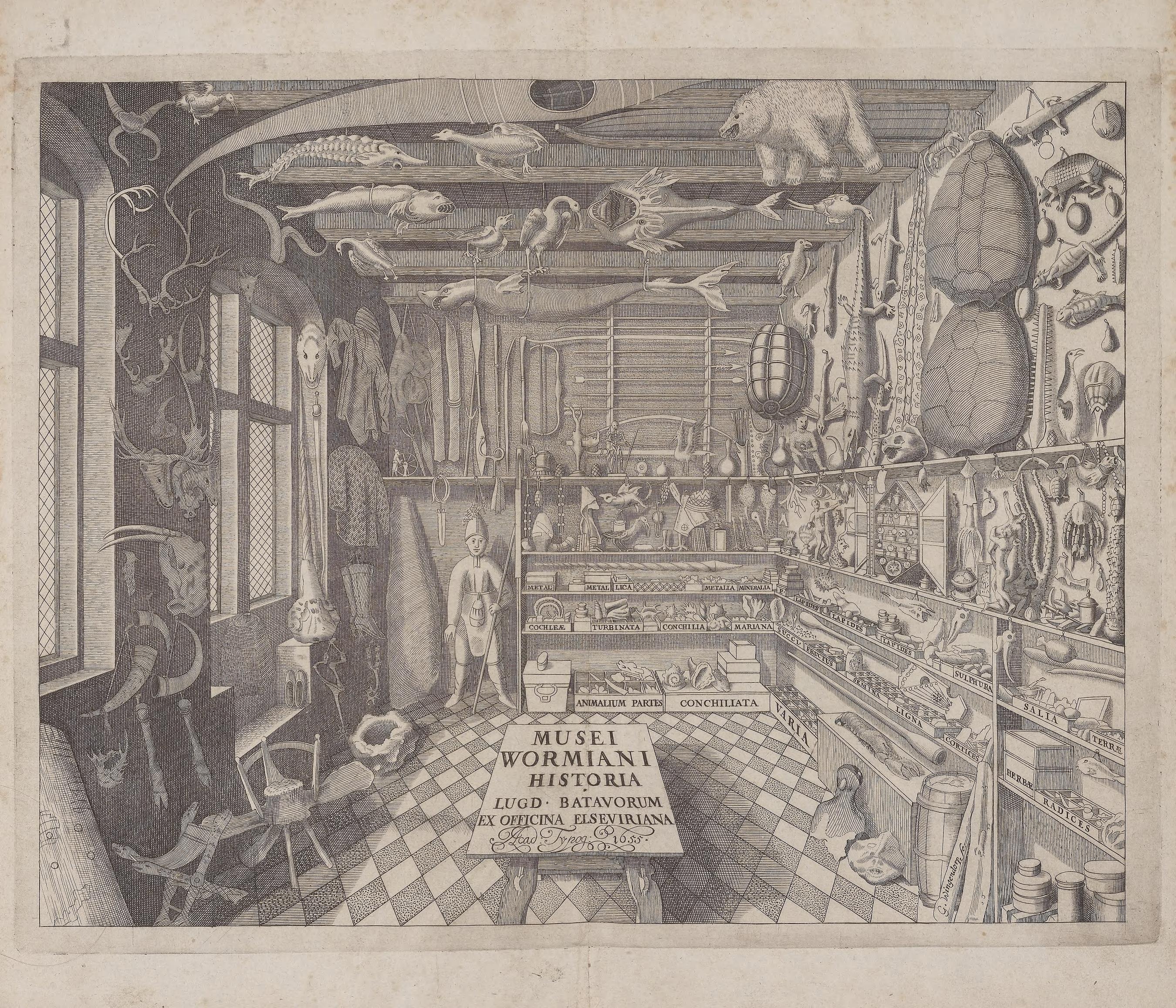
Long before natural history collections were sorted into their proper drawers, cabinets of curiosities held the real and the mythical side by side, often with no need to settle which was which.
Ole Worm (1588–1654) kept one of them. He was a Danish physician and antiquary who taught Greek, Latin, physics and medicine at Copenhagen, served as physician to Christian IV, and spent years reading runestones. The room in the engraving above is his own: the collection he kept at home, catalogued after his death as Museum Wormianum.
He kept what he had been sold as a unicorn horn, doubted it enough to go looking for proof, and in 1638 matched it to a narwhal’s skull. Even once he was right, the courts of Europe went on prizing narwhal tusks as unicorn horns for a long while after, because the wonder of the thing had outgrown its label.
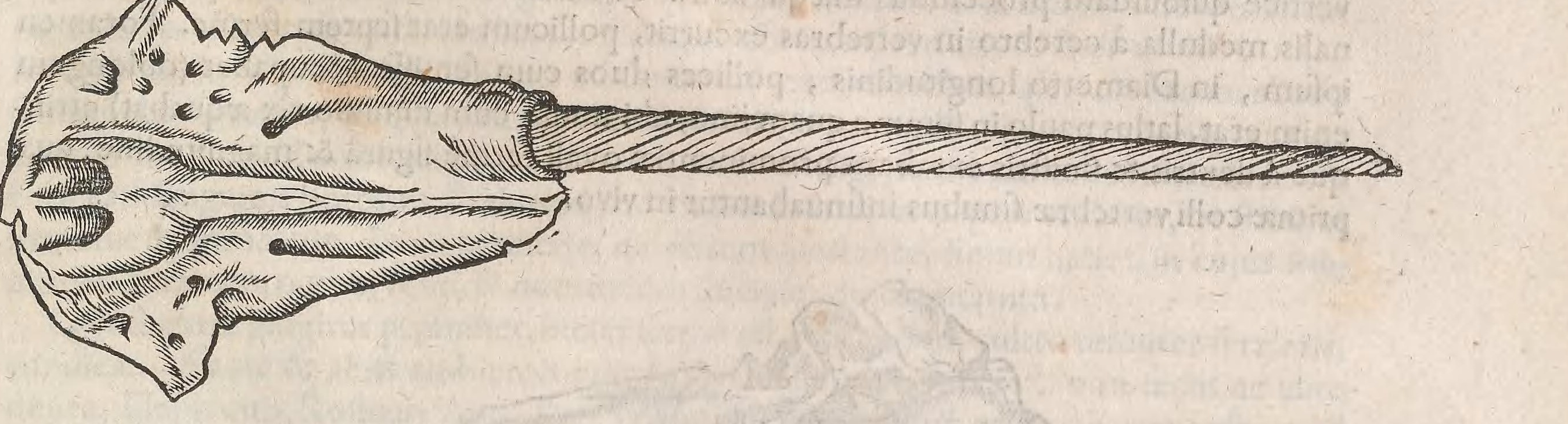
A cabinet like this asks its keeper to hold two things at once, curiosity and classification, without letting the second one win too quickly. That is not so different from what it means to sit with a mind, including one’s own, that keeps refusing to be filed neatly away.
Monotropic flow Link to this section
None of this needed to be urgent. Bagpuss did not rush toward usefulness, and neither does a cabinet of curiosities, and neither does a mind following the pull of its own attention wherever it leads.
What gets called a special interest in clinical language is, from the inside, something closer to a small cabinet of curiosities kept and tended by the person themselves rather than assembled by someone else’s eye. Curating your own wonder, choosing what gets kept and what it means, is a quietly radical act when so much of the world still expects you to hand that decision to somebody else.
Paul Klee’s herbarium is a cabinet of exactly this kind. He gathered it for ten years, mounted it with care on paper he painted himself, left it unlabelled, and never used the specimens in his work. Flannery wonders whether it was meant as a source of designs; ten years is a long while to tend a source you never draw from. It looks more like attention that had found somewhere to go and was allowed to stay there.
Monotropism is Dinah Murray’s theory, developed with Mike Lesser and Wenn Lawson: attention as a resource that pools deeply in a few interests at a time rather than spreading thinly across many. The reading above is what that looks like from inside a life rather than from across a desk.
Field note. Restoration of meaning, not repair. Attention, not urgency. A cabinet kept by the one who fills it.
Bring something forward Link to this section
What is the thing you have been keeping without quite knowing why? A shell, a phrase, a scrap of a television programme half remembered from childhood, an interest nobody else in the room seems to share.
Bring it forward the way Emily does, not to have it fixed, but to have it looked at properly, turned over, wondered about. Queering Earth is a cabinet of exactly this kind, herbarium sheets for the thoughts and objects and stories that do not need straightening out to be worth keeping.
Consider this an open invitation to add your own sheet to the collection.
Sources Link to this section
Emily’s verse is quoted from Smallfilms’ own text — Oliver Postgate and Peter Firmin’s site, which prints the opening narration in full. It is six lines, not five. Two circulating versions are both wrong, in different directions: the reference works give Old Fat Furry Catpuss
, capitalised throughout and unhyphenated, and run Wake up, be bright, be golden and light
together as one line. Postgate hyphenates cat-puss, capitalises only the first word of each line and the Oh
, and breaks the middle into two lines. It is spoken narration and not a song, which matters because the songs in the series are somebody else’s work: the folk songs were put together and performed by Sandra Kerr and John Faulkner, who also voiced Madeleine and Gabriel. Emily was played by Emily Firmin, daughter of the series’ co-creator.
The series’ own page is at the BBC. The herbarium material, Klee included, is Maura C. Flannery, The Herbarium as Muse: Plant Specimens as Inspiration, Biology International 53 (2013), 23–34. The paper is in the house library.
Monotropism is Dinah Murray, Mike Lesser and Wenn Lawson, Attention, monotropism and the diagnostic criteria for autism, Autism 9:2 (2005), 139–156, doi:10.1177/1362361305051398. Its third author is Wenn Lawson, and the journal’s byline is not the name he uses — the DOI is what makes the paper findable, so nothing here reproduces the old one. Helen keeps a resource page at Autistic Realms; Fergus Murray keeps monotropism.org.
Ole Worm’s demonstration is dated 1638, when he matched the horn to a narwhal’s skull. His Museum Wormianum was published posthumously in 1655 by his son.
The reading began as Helen Edgar, Bagpuss: Lost things. Holding space for emergence & joy, Autistic Realms, 11 September 2026.